

A class of Madhyamik students from Kolkata were puzzled by “She go to school every day.” They were confused about subject-verb agreement. This shows how exam pressure and small habits can make simple rules hard.
This moment changed how we teach. We focus on practical, focused, and kind learning.
The West Bengal Madhyamik English paper is carefully made. Teachers know that spelling matters in language papers. This is important for students studying for the Madhyamik English syllabus and question paper.
We aim to clear up common mistakes and give useful tips for exams. Our goal is to make learning grammar, vocabulary, and exam strategy fun and inspiring. We help students, teachers, and engineering professionals.
For coaching, resources, or partnerships, call +91 8927312727 or email info@nextstep.ac. These pages will help you find and fix mistakes. They will make you feel ready for exams.
Understanding the Importance of Madhyamik English

Madhyamik English is key for students aiming at technical education and jobs. It helps with clear thinking, writing, and speaking. Knowing the Madhyamik English syllabus helps students study better for exams.
From the board’s view, exams are designed to be fair. Question papers follow rules and weightage. This ensures students are treated fairly and exams are valid.
The Role of English in Education
English connects classroom learning to real-world jobs. It’s used in reports, projects, and presentations. Teachers use the Madhyamik English syllabus to make lessons more effective.
Spelling and grammar are important. Teachers should focus on these skills. Short tests help students get better at them.
Expectations in Madhyamik Exams
Students need to know about spelling, grammar, understanding, and writing. Knowing what to expect helps them study better. They can use past papers to practice.
Reading, writing, and practicing answers are good study habits. This helps students feel more confident during exams.
| Focus Area | What Examiners Look For | Study Action |
|---|---|---|
| Spelling & Accuracy | Correct orthography across answers; penalties for repeated errors | Daily dictation drills and spelling lists from the Madhyamik English syllabus |
| Grammar & Sentence Structure | Clarity, correct tense use, and subject-verb agreement | Targeted exercises and short composition practice with teacher feedback |
| Comprehension | Ability to extract key ideas and answer precisely | Practice past West Bengal Madhyamik English passages under time limits |
| Composition | Organized content, clear introductions, and relevant conclusions | Outline planning, peer review, and writing multiple drafts |
Common Grammatical Errors
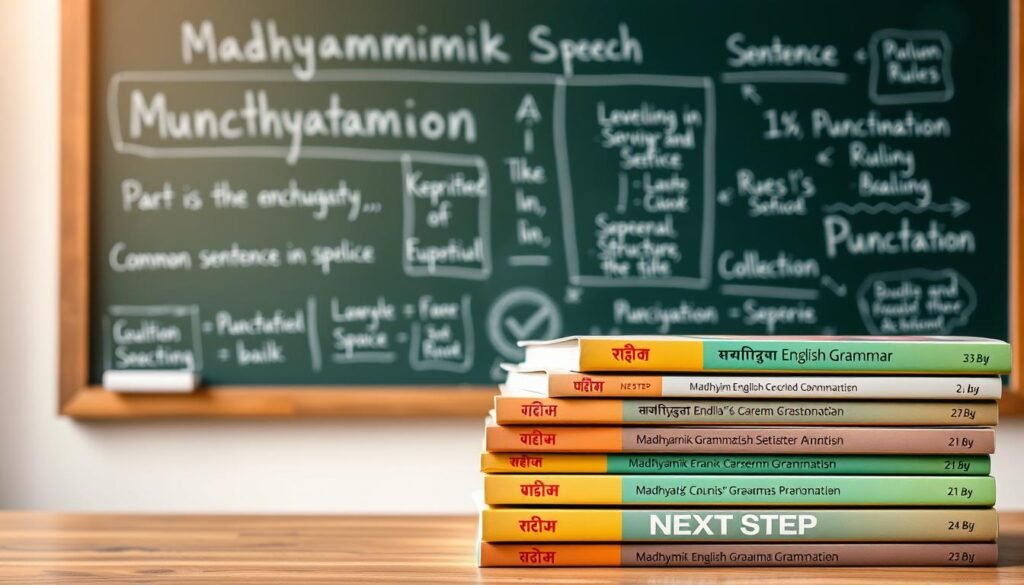
We list the grammar mistakes that can lose students marks in Madhyamik English. Mistakes in subject-verb pairing, tense, or prepositions can change the meaning. We offer clear patterns, quick checks, and drills to help learners fix these mistakes before they submit.
Subject-Verb Agreement Confusions
Students often get the verb wrong when dealing with collective nouns or compound subjects. For example, saying “The team are” instead of “The team is.” Or “Either Ravi or the girls were” instead of “Either Ravi or the girls are.” These mistakes happen in both composition and grammar.
Practice approach: make short drills where we change the subject and check the verb. Using lists from Madhyamik English grammar exercises helps make agreement automatic under pressure.
Misuse of Tenses
Students sometimes change the time frame in a paragraph. They might start in past tense and then switch to present tense. This makes the text confusing and lowers clarity in Madhyamik English composition.
Remediation: plan the timeline for each paragraph before writing. We suggest timeline mapping exercises and prompts from past papers to practice consistent tense use. Focused practice helps avoid common mistakes with verb forms.
Incorrect Prepositions
Preposition errors can change the meaning: “depend on” versus “depend of,” or “arrive to” instead of “arrive at.” These small words often get missed in proofreading and reduce the precision of answers.
Targeted fix: make a short list of common prepositions found in exam questions. Practice replacing wrong phrases with the correct ones. Exercises from Madhyamik English grammar sections in textbooks help strengthen usage.
Vocabulary Mistakes Students Make
Students often make three big mistakes with words. These mistakes can hurt their scores in the Madhyamik exam. Choosing the right words can make a big difference.
Overusing Common Words
Students often use words like “good,” “bad,” or “important” too much. This makes their writing sound dull. Using stronger words can make their points clearer and get them more points.
We suggest making a list of better words. Use the Madhyamik English textbook to find synonyms. Practice using these words in short sentences. This will help in essays and answers.
Contextual Misunderstandings
Words that work in one sentence might not work in another. The way words go together matters a lot. Using words from another language can lead to mistakes.
To avoid this, write sentences for each word. Check these sentences against sample tasks from the Madhyamik English question paper. This will help you see how words change meaning.
Confusing Synonyms
Near-synonyms have similar but not the same meanings. Picking the wrong one can change the whole meaning. For example, “agree” and “concur” have different tones.
Here’s a tip: learn words with their usual partners and meanings. Use the Madhyamik English textbook for exercises. Mark where you see word substitutions in past Madhyamik English question papers.
- Tip: Learn collocations, not isolated words.
- Tip: Create mini-quizzes from textbook lists.
- Tip: Practice replacements in timed writing to mirror exam pressure.
Punctuation Errors in English Writing

We look at common mistakes in punctuation. These mistakes make writing unclear and can hurt exam scores. We give tips and practice to help students avoid these errors in their Madhyamik English work.
Misplaced Commas and Periods
Comma splices mix two complete sentences with just a comma. This makes the meaning unclear. Use a period, semicolon, or a conjunction to join sentences properly.
Short sentences are easier to write and read. They help avoid mistakes when time is short.
Here’s a checklist for practice: read your work out loud to spot mistakes. Mark sentence breaks in old papers. Try to have one main idea per sentence. These steps help improve your Madhyamik English skills.
Quotation Marks Mishaps
Students often get quotation marks wrong. They forget to add punctuation inside the marks. In direct quotes, keep commas and periods inside the marks.
For nested speech, use double and single marks correctly. This makes your quotes clear. Practice by marking up old papers and model answers.
Apostrophes: A Common Pitfall
Apostrophes show possession or missing letters, not plural. Mistakes like “writers'” for “many writers” make essays hard to read. Teach the rule by comparing: “the teacher’s book” (possession) vs. “teachers” (plural).
Practice by making correction lists from examiners’ notes. Check each other’s work and do timed drills on old papers. These steps help you learn punctuation rules and improve your Madhyamik English skills.
Structuring English Essays

We stress clear structure: a brief outline is the backbone of a cohesive piece. Good structure guides the examiner through your argument and boosts clarity. Use time in the exam to sketch a plan that maps introduction, body, and conclusion to the question.
The Importance of an Outline
We recommend drafting a 3–5 line outline in the first three to five minutes. That quick plan keeps the essay on track and saves time when writing. For Madhyamik English composition, examiners reward organization and relevance above ornate language.
Start with a thesis line, list two or three body points in order, and note a closing idea. This simple Madhyamik English suggestion helps maintain focus under time pressure.
Crafting Strong Introductions
We craft introductions to present the thesis and a short roadmap. A single clear thesis sentence signals your stance. Add one or two lines that preview the body paragraphs.
For exam answers, avoid long generalities. Short, direct intros match the Madhyamik English essay structure teachers expect.
Writing Effective Conclusions
We close by synthesizing key points and restating the thesis in fresh words. Conclusions should tie examples back to the main idea. Avoid repeating earlier sentences verbatim.
Use a two- to three-line wrap-up that highlights impact or a practical suggestion. This final touch often improves the coherence score in Madhyamik English composition grading.
Practice tip: expose yourself to past paper prompts and write timed outlines. Use a short self-edit checklist focused on flow, topic sentences, and relevance. These steps form a compact Madhyamik English suggestion that yields steady gains.
| Stage | Time (minutes) | Purpose |
|---|---|---|
| Outline | 3–5 | Define thesis and order of body points |
| Introduction | 3–5 | Present thesis and roadmap clearly |
| Body Paragraphs | 20–30 | Develop topic sentences, examples from textbook or real life |
| Conclusion | 3–5 | Synthesize points, restate thesis in new words |
| Quick Self-Edit | 2–4 | Check structure, flow, and relevance to question |
Common Reading Comprehension Issues

Students often struggle with Madhyamik English passages. They might misread the task or miss important clues. Test makers for West Bengal Madhyamik English create questions to test recall, analysis, and inference.
Start by quickly looking over the questions. This helps set your reading goals. Look for specific names, dates, or phrases to focus on.
Misinterpreting Questions
Students sometimes think inference questions are literal. We tell them to watch for words like “suggests”, “implies”, or “most likely”. If a question asks for a direct fact, check the sentence that states it.
Identifying Key Details
Using annotations is helpful. Underline topic sentences and circle names. Make quick notes in the margins. This helps remember important details under pressure.
Practice with past Madhyamik English question papers. Compare your answers with model responses. This shows which details are most important to examiners.
Skimming vs. Scanning
Skimming helps you understand the overall structure and tone. Use it to get a quick sense of the passage. Scanning is for finding specific facts or numbers.
Practice switching between skimming and scanning. Do timed drills to get faster without losing accuracy.
Practice timed tests that mimic the exam. Use passages from West Bengal Madhyamik English resources. Check your answers against examiner rubrics. This helps understand marking patterns and when to read slowly or quickly.
Using Formal vs. Informal Language

We teach students to pick the right tone for exams. A formal tone makes things clear and shows you know your grammar. For personal notes or chats, informal language is okay if the question says so.
The Appropriate Tone for Essays
For essays, we say use a calm, clear voice. Write full sentences and pick different words. This makes your points stronger and follows the usual ways of writing in exams.
When to Use Colloquial Terms
Use everyday words only when you’re writing to a friend, in a diary, or as a character. It’s okay to sound natural, but keep it clear and right.
Avoiding Slang in Academic Writing
We tell students to stay away from slang and casual sayings in school work. Using slang can hurt your score. Try rewriting simple words into more formal ones to get better.
- Rule 1: Choose clear words over vague ones.
- Rule 2: Match your tone to the task — formal for essays, personal for notes.
- Rule 3: Check examples in the Madhyamik syllabus and model answers.
Developing a Strong Thesis Statement

We start by defining the thesis. It’s a short claim that guides our essay. A clear thesis keeps the reader focused and helps us shape each paragraph to support one main idea. This makes our Madhyamik English composition and essay structure stronger in exams.
Characteristics of a Good Thesis
A good thesis is specific, defendable, and matches the prompt. It should not be vague and must be something we can prove with evidence. Short, direct sentences are best for exams.
Use examples from class and past questions to check if it’s clear.
The Thesis and Overall Argument
The thesis is the anchor for our paragraph development. Topic sentences should link back to it. Essays that build each paragraph around the thesis score better.
When we connect examples, explanations, and linking phrases to the thesis, our coherence scores go up.
Revising Your Thesis for Clarity
First, write a working thesis in your outline. Then, refine it after planning your body points. If a paragraph goes off track, edit the thesis or reshape the paragraph to keep it aligned. This habit helps us improve steadily.
- Write a tentative thesis before drafting.
- Match each paragraph to one aspect of the thesis.
- Use past Madhyamik English composition prompts for practice.
Revising and Editing Your Work

We do two things: we shape ideas and fix language. Revising makes your argument flow better. It makes introductions strong and each paragraph clear.
Editing fixes small mistakes like grammar and punctuation. It makes sentences clear and easy to read.
The Difference Between Revising and Editing
Revising is about the big picture. It checks if your answer is good and if your thesis is clear. It also makes sure your evidence makes sense.
Editing is about the small stuff. It looks for spelling, punctuation, and sentence mistakes. Start with big changes, then fix the small stuff.
Tips for Self-Editing
Read your work out loud. This helps you find awkward parts and mistakes. It’s easier to spot tense errors and subject-verb problems this way.
Make a checklist for editing. Check for subject-verb agreement and tense. Also, look for punctuation and spelling errors. Keep your checks organized.
Save time at the end for editing. Fix common mistakes and make your writing clear. This can really help your score.
Using Peer Feedback Effectively
Use a rubric for peer review. It should match the Madhyamik marking scheme. Look at thesis clarity, paragraph coherence, grammar, and relevance.
Exchange your work with a peer. Use the rubric to give feedback. Then, compare your feedback with model answers and what examiners expect. This makes feedback useful for improving your work.
Preparing for the English Exam
We have a plan to help you feel ready. First, learn the Madhyamik English syllabus. Then, make a study plan with grammar, reading, and writing.
Short study sessions help you remember better. They also prevent feeling too tired.
Effective Study Techniques
Make a weekly study plan. Spend time on grammar and vocabulary. Use real-life texts for practice.
Practice with old exams to know what to expect. Use them to find areas you need to work on.
Practicing Writing Under Pressure
Practice writing under timed conditions. Start with a draft, then time yourself. This builds your endurance.
For essays, make an outline quickly. Practice your project as a short task to improve your skills.
Time Management During the Exam
Plan your time before starting. Focus on important questions first. Spend more time on essays that count more.
Save the last ten minutes for checking your work. If unsure, use past exams to guide you. For help, call +91 8927312727 or email info@nextstep.ac.
| Focus Area | Action | Weekly Time |
|---|---|---|
| Grammar drills | Targeted exercises on tenses and agreement | 3 hours |
| Reading practice | Editorials and comprehension passages | 2 hours |
| Past paper practice | Timed Madhyamik English question paper practice sessions | 4 hours |
| Writing & projects | Madhyamik English project drafts and timed essays | 3 hours |
| Revision & proofing | Short, focused review and proofreading drills | 2 hours |
Resources for Improving English Skills
We suggest a mix of books and practice to improve Madhyamik English. Start with the Madhyamik English textbook and guides from the board. Then, use grammar and composition workbooks to fix common mistakes.
Recommended Books and Study Guides
First, use the Madhyamik English textbook. Then, add guides from trusted publishers. Use grammar workbooks to practice and learn from common errors.
Online Platforms for Practice
Practice online with EdTech tools. Sites like PrepAI offer many types of questions. They help you get ready for exams.
Engaging with English Media
Read English newspapers and magazines. Watch videos with English subtitles. For help, call +91 8927312727 or email info@nextstep.ac.