

In a classroom at St. Xavier’s, a group of Class 12 students changed their study game. They stopped studying at midnight and started short, focused study sessions. Soon, their mock test scores went up and they felt less stressed.
This is what we want for you in this guide. These 15 revision hacks are for anyone getting ready for the Higher Secondary Board Exam. This includes the 12th Grade Exam, the Class 12 Board Exam, the HSC Exam, and the 10+2 Board Exam in India.
We mix study science with proven classroom methods. These include planning, getting enough sleep, using flashcards, and timed tests. We also suggest apps, learning with friends, making notes short, and using past papers wisely.
Each tip helps you remember better, manage your time, and feel less stressed. This leads to higher marks without the last-minute rush.
As you read, you’ll find easy steps and examples. We’ll show you how to make a study plan that works for you. For more help, NextStep offers mentoring and custom plans. Call us at +91 8927312727 or email info@nextstep.ac.
Understanding the Higher Secondary Board Exam

The Higher Secondary Board Exam is a big step in a student’s school life. It happens at the end of Class 12. How well you do can affect your college plans, scholarship chances, and entry into engineering tests.
What Is the Higher Secondary Board Exam?
The Higher Secondary Board Exam is also known as the Class 12 Board Exam. It gives you the Higher Secondary Certificate. Schools like CBSE, ICSE, and state boards have their own rules for the exam.
Some schools also have internal tests or practicals. The term Intermediate Board Exam is used in some places. It means the same exam that shows you’ve finished 10+2 schooling.
Importance of This Exam in Your Education Path
This exam is very important for students who want to be engineers. Doing well in the Class 12 Board Exam can help you get into good colleges. It also increases your chances in engineering exams.
But, if you don’t do well, you might have fewer choices. We suggest focusing on understanding the material, not just memorizing it. This helps with engineering problems and remembering things for a long time.
Start by planning your study time based on the exam’s format and important topics. Use NCERT and other materials your school recommends. Practice with past papers to get used to the exam style and how to manage your time.
Setting Up a Productive Study Environment
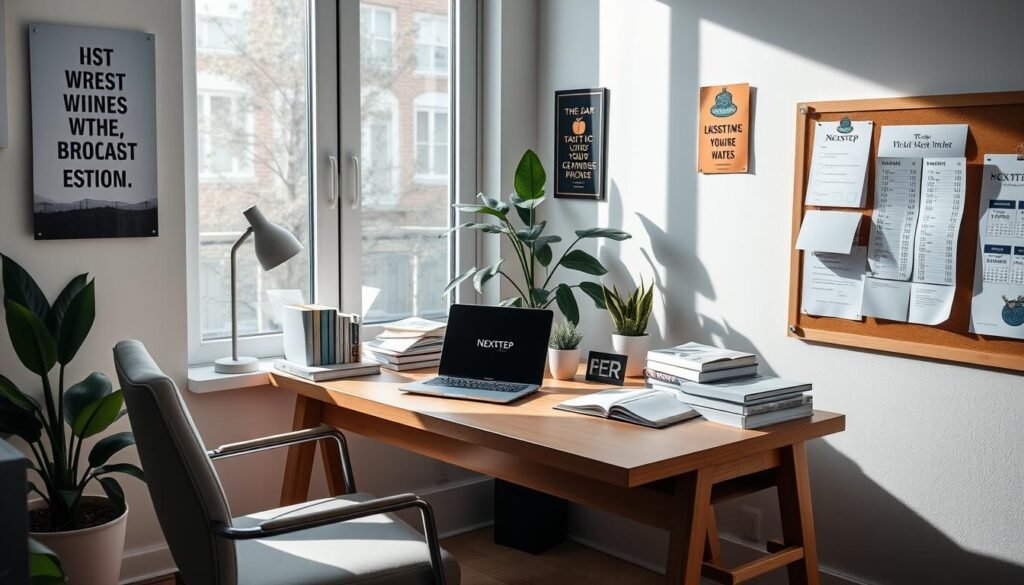
A calm, organized study space helps a lot when you’re getting ready for the Higher Secondary Board Exam. It makes solving problems easier and keeps you motivated. This is key for the long study times needed for the 12th Grade Exam and Class 12 Board Exam.
Find a spot with natural light, good air, and a comfy chair. You’ll need a big desk for books, notes, and practice papers. For engineering, set up a corner with a whiteboard or big sheets for drawing.
Put important books like NCERT and references close by. Use labeled trays for pens, calculators, and templates. This saves time looking for things during focused study.
Choosing the Right Space to Study
Choose one main study area instead of moving around. This helps your brain focus better. Keep the walls simple and the room tidy.
Make sure your desk and chair are the right height. This keeps your elbows and knees at 90 degrees to avoid pain. Keep a water bottle nearby to stay hydrated during long study sessions.
Minimizing Distractions for Maximum Focus
Use app timers and website blockers to stay focused. Turn your phone to Do Not Disturb or airplane mode to avoid distractions. This is important for intense study sessions for the 12th Grade Exam.
Post a study schedule at your room door. This tells family when you’re not to be disturbed. Use noise-cancelling headphones or find a quiet spot when it gets noisy.
Try short, focused study sessions like Pomodoro. This helps you remember things better. Take breaks to stand, stretch, or walk to avoid eye strain and tiredness.
| Element | Why It Helps | Practical Tip |
|---|---|---|
| Lighting | Reduces eye strain and boosts alertness | Use daylight where possible; add a neutral desk lamp for evenings |
| Ergonomics | Prevents posture fatigue during long problem-solving sessions | Adjust chair and monitor height; maintain feet flat on floor |
| Work zone for engineering | Provides space for complex derivations and circuit work | Install a whiteboard or large sheets and keep markers handy |
| Device management | Limits digital distraction during core study blocks | Use Do Not Disturb, app timers, and website blockers |
| Visual simplicity | Helps sustain concentration and reduce decision fatigue | Choose soft wall colors, minimal décor, and tidy surfaces |
| Hydration and breaks | Maintains cognitive function and reduces eye strain | Keep water nearby; take short walks after each Pomodoro |
Creating a Study Schedule That Works

We make study plans that fit your life. They are clear, flexible, and help you learn best. A good schedule connects daily tasks with big goals for exams.
Time Management Tips for Students
Begin with a weekly and monthly plan. Mark important dates and goals. Give more time to hard chapters and areas you struggle with.
Do hard subjects when you’re most alert. Use quiet times for easy review. This helps you remember better for exams.
Group similar tasks together. Do problem-solving then move to reading. Switch subjects to avoid getting tired. This keeps you going for exams.
Structuring Daily Study Blocks
Use 25–50 minute blocks with 5–15 minute breaks. Start each block with a quick review. This helps you remember better.
Make time for mock tests and past papers. Use weekends for full exams. End each day with a quick review of what you did.
- Block example: 40 min focus, 10 min break — repeat three times, then 30–60 min break.
- Daily mix: one core subject, one practice session, one light revision slot.
- Weekly goal: complete a past paper and review mistakes for the Class 12 Board Exam.
Be realistic with your schedule. A doable plan builds confidence. With steady effort, you can prepare well for exams.
Active Learning Techniques for Better Retention
We focus on methods that help students learn actively. These methods improve memory and understanding. They are great for anyone studying for the Higher Secondary Board Exam or the 12th Grade Exam.
Using Flashcards Effectively
Make flashcards with key information. Keep each card simple so you can remember easily.
Use the Leitner system to organize cards. This helps you remember better for the Class 12 Board Exam.
For subjects like biology and chemistry, add sketches and notes on the back. For physics and engineering, make cards with problem steps. This helps you solve problems faster.
The Feynman Technique for Complex Topics
Try explaining a topic in simple words. This helps you find what you don’t know.
When you find gaps, look at NCERT or trusted books. Then, explain it again in simple terms. This makes you understand better for the Higher Secondary Certificate Exam.
Use simple examples to explain hard ideas. Then, go back to the formal explanation. This helps you see what you don’t get and makes your understanding stronger for the Class 12 Board Exam.
Practice Tests: The Key to Self-Evaluation
Do timed mock tests and old papers. This helps you learn to manage your time for the 12th Grade Exam.
After each test, check your mistakes. Label them as mistakes, careless errors, or time issues. Make drills to fix these mistakes and take tests again after practicing.
Plan spaced revision with flashcards and Feynman sessions. Also, do full-length practice tests every two weeks before the Higher Secondary Board Exam. This helps you see how you’re doing and adjust your study plan for the Higher Secondary Certificate Exam.
Incorporating Technology in Your Revision

We use technology to make studying better for the HSC Exam and Higher Secondary Board Exam. Digital tools help us study faster, track our progress, and make studying active. Here are some steps to use apps and videos wisely.
Utilizing Educational Apps for Revision
Anki is great for flashcards that help you remember things. Google Keep and Notion are good for organizing your notes and to-do lists. They help you make quick revision cards for the 12th Grade Exam.
For solving problems, use apps that show how to do it step by step. BYJU’S, Khan Academy, and Unacademy explain things clearly. They are good to use along with your textbooks for the 10+2 Board Exam.
Set goals for your app use, like reviewing a deck or solving problems. Use tools to keep track of your screen time. This helps you stay focused and avoid distractions.
YouTube as a Learning Tool
YouTube is like having a visual teacher for hard topics in the Higher Secondary Board Exam. Khan Academy and NPTEL explain things well. Indian channels offer examples that match the board exam patterns.
Make playlists for each subject and slow down videos for hard parts. Take notes and try to solve the next step before watching the solution. Make watching videos active by summarizing, solving problems, or teaching someone else.
Turn off autoplay and download videos for offline use to stay focused. Short video sessions, like a 20-minute explainer followed by 30 minutes of practice, are good for 12th Grade Exam prep.
| Tool | Best Use | How It Helps 10+2 Board Exam Prep |
|---|---|---|
| Anki | Spaced-repetition flashcards | Improves retention of formulas, definitions, and dates for board exams |
| Notion / Google Keep | Note organisation and quick revision cards | Makes topic summaries and revision plans easy to access during 12th Grade Exam study |
| BYJU’S / Unacademy | Concept explanation and practice questions | Provides alternate explanations aligned with board syllabus for the Higher Secondary Board Exam |
| Khan Academy / NPTEL (YouTube) | Video lessons and visual proofs | Clarifies difficult concepts and supports engineering-style thinking for HSC Exam topics |
| Screen-time tools | Limit usage; schedule focus windows | Prevents distraction during critical revision for the 10+2 Board Exam |
Developing Strong Study Habits
We think good habits make hard work last. For students getting ready for the Class 12 Board Exam, small steps every day help a lot. These steps build confidence and cut down stress.
Start with something you already do. Study after breakfast or right after school. This makes you focus better. Use simple lists or a habit tracker to see your progress.
The Power of Consistency
Short, daily study beats cramming. Do five to six problems a day for a week. This makes you better at solving problems and less stressed for exams.
Make a plan for daily study: 25–40 minutes with clear goals. After, write down what you did better. This helps you learn more each time.
Rewarding Yourself to Stay Motivated
Give yourself small rewards for reaching goals. A short walk, a favorite snack, or a break from apps. Big rewards for a whole week, like watching a movie or hanging out with friends.
Don’t let too much social media be a reward. Instead, set times for rewards. This keeps you on track for exams.
- Anchor: Link study to an established daily habit.
- Track: Use a habit tracker to record streaks and tasks.
- Reflect: End the week with brief notes on what worked.
- Reward: Choose timed, proportionate rewards that reinforce progress.
We focus on being consistent, measuring progress, and rewarding wisely. These strategies help make studying for exams easier and more effective.
Collaborating with Study Groups
We learn faster when we work together. Small, well-run study groups make studying fun. We can test ideas, find gaps, and share shortcuts.
Benefits of Peer Learning
Teaching others helps us learn better. It’s like a rehearsal for the exam. It boosts our confidence for the Higher Secondary Board Exam.
Groups help us find what we don’t know. We share notes, practice problems, and get ready for the exam. We learn new ways to solve problems.
Finding the Right Study Partners
Choose friends who study like you. Having different strengths helps everyone. Keep the group small to stay focused.
Plan what to do before meeting. Pick a leader to keep things moving. Use online tools for notes and questions.
Make sure everyone has a task. Start and end on time. This keeps everyone on track.
Mastering Note-Taking Skills
Good notes make studying better. They help us remember more. Here are tips for making notes that work for all subjects.
Different Note-Taking Methods Explained
Cornell notes are great for summaries. They have a cue column, a notes column, and a summary at the end. Use the cue column for key words and questions.
Mind maps are good for seeing how things connect. Put the main topic in the middle and add subtopics and examples. This helps us remember better for exams.
Outline notes are best for subjects like history. They have numbered points and subpoints. This makes it easy to follow timelines and events.
For math and science, write down solutions step by step. Start with the problem and show each step. Keep a formula sheet handy for quick checks.
Organizing Your Notes for Quick Review
Make every page the same: heading, date, topic, and key points. Short notes help us remember faster.
Use colors to mark weak areas and mastered topics. This helps us know what to focus on without looking at every page.
Put notes on your phone or computer. This way, you can search and access them anywhere. It’s great for studying for exams.
Make a one-page summary for each chapter. Include important formulas, key points, and sample problems. This is perfect for quick reviews before exams.
Make your notes active by leaving spaces to fill in answers. This turns your notes into practice tests. It helps you remember better for exams.
| Method | Best For | Key Element | Revision Benefit |
|---|---|---|---|
| Cornell Notes | Concept-heavy chapters | Cue column + summary | Fast self-testing and concise reviews |
| Mind Maps | Interconnected topics | Central node with branches | Visual recall and link recognition |
| Outline / Nested Lists | Chronological or linear subjects | Numbered headers and subpoints | Quick scanning of sequences and facts |
| Worked Solutions & Formula Sheets | Math, Physics, Chemistry | Step-by-step derivations and final formulas | Efficient problem solving and formula recall |
| One-Page Dossier | End-of-chapter revision | Essentials: formulas, points, examples | Rapid last-minute preparation |
Utilizing Previous Exams for Practice

We make old exams a key tool to get better for the Higher Secondary Board Exam. They show us what questions are often asked and what topics are important. This helps students focus on what they need to work on the most.
Where to find good old exams: official board sites, school libraries, and coaching centers. The CBSE website and state board sites have papers from past years. You can find them printed or online, sorted by subject and year.
Here’s a simple guide to get old exams: check the year, pick the right subject, and get the answer keys. Organize your papers by year and subject. This makes it easier to practice for the Higher Secondary Certificate Exam.
Look for patterns in old exams to make a good study plan. Find out which chapters are tested often and how marks are given. Short-answer and one-mark questions often come up, so focus on those areas.
Use what you find to make a study plan. List topics, how often they’re tested, and how many marks they’re worth. Spend more time on areas with long-answer questions.
Practice under timed conditions and check your mistakes. Note down common errors and weak spots. Use this info to plan your study time better.
Here’s a quick guide to help you find and use old exams for each exam type.
| Source | What to Download | How It Helps |
|---|---|---|
| CBSE official portal | Question papers, marking schemes, sample answers | Authentic format and model answers for the Class 12 Board Exam |
| State board websites | Year-wise papers, subject-wise archives | Regional syllabus alignment for the Higher Secondary Board Exam |
| Coaching institutes (e.g., Allen, Aakash) | Compiled practice sets, topic-wise tests | Focused drills and exam-style variations useful for the Senior Secondary Exam |
| School repositories | Internal tests, past final papers | Local grading patterns and frequently asked sections for the Higher Secondary Certificate Exam |
| Digital libraries (NCERT, exam prep platforms) | Indexed papers, solution banks | Easy searching and filtered practice by year and topic |
Stress Management Techniques for Exam Preparation
Exam season can feel very intense. Students getting ready for the 12th Grade Exam or HSC Exam can find small habits to help. These habits can make studying for the Higher Secondary Board Exam or Class 12 Board Exam easier.
Try short mindfulness sessions between study times. Start with five minutes of breathing and body-scan meditation. If it helps, do 15–20 minutes. Use apps like Insight Timer or Headspace for guided routines.
Make a break schedule: after two to three hours of study, take a 15–20 minute break. Use this time for breathing exercises or a brief meditation. This can help lower test anxiety and improve memory for the 12th Grade Exam and Class 12 Board Exam.
Physical activity is good for your mind and mood. A 20-minute walk, a short aerobic set, or light yoga can help. Specific breathing techniques, like alternate nostril breathing, can calm nerves before exams.
Don’t skip sleep. Try to get seven to eight hours each night. This helps solidify learning and keeps you focused during long study sessions. Remember, practice test gains fade without rest.
Try mixing different techniques to find what works for you. Mix two short meditations, one light yoga session, and regular sleep. This can help manage stress for the HSC Exam and Higher Secondary Board Exam.
Preparing for Exam Day
Exam day can feel big, so we make a clear plan to help you feel calm and sharp. Start your morning with a calm routine: a checklist, essentials, and a quick mental warm-up. This helps you face the Higher Secondary Board Exam, Class 12 Board Exam, 10+2 Board Exam, or Higher Secondary Certificate Exam with confidence.
What to Pack
Get everything ready the night before: your admit card, ID, pens, pencils, eraser, and sharpener. If allowed, pack a calculator and a small watch. Bring a water bottle and a formula sheet if rules permit. Wear comfy clothes and have any needed medicine ready to avoid stress.
Mental Preparation Strategies
Use the first 15 minutes to scan the paper and mark important questions. Start with easy questions to build confidence. Do two-minute breathing exercises to calm your nerves before you start.
Stick to what you’ve learned: don’t try new things on exam day. Review quick summaries or formula sheets instead. After the exam, jot down areas you need to work on. But don’t worry too much about mistakes. For help with revision, mock tests, or engineering paths, call NextStep at +91 8927312727 or email info@nextstep.ac.